How to Choose the Best Solar Panels for Your Business Needs?
Choosing the best solar panels for your business is crucial. According to Dr. Lisa Mendoza, a leading expert in renewable energy, "Selecting the right solar panels can significantly impact your energy costs and sustainability goals." Businesses today face the challenge of balancing energy needs with environmental responsibility.
Solar panels vary in efficiency, cost, and technology. It's essential to assess your specific needs before making a choice. For instance, different locations receive varying sunlight exposure, which affects panel performance. Additionally, understanding your energy consumption patterns helps in selecting the right system size.
Investing in solar panels is not just about the initial cost. Maintenance, longevity, and warranty also matter. Often, businesses overlook these factors, leading to regret later. While premium options may seem daunting price-wise, their efficiency can yield savings over time. Choosing solar panels requires both careful consideration and informed decision-making.

Understanding Your Business Energy Requirements
Understanding your business energy requirements is essential when selecting solar panels. Businesses often underestimate their energy consumption. A report by the U.S. Energy Information Administration indicates that commercial buildings consume an average of 19.2 kilowatt-hours per square foot each year. This figure may vary greatly, depending on the industry and specific operational needs.
Determining your peak energy usage times is crucial. This helps in sizing your solar panel system accurately. For instance, if your business operates during daylight hours, you might benefit more from solar energy. Regular audits of your energy usage can reveal patterns that provide insights for optimal solar panel selection.
Consider factors such as space, budget, and specific energy goals. If your building has limited roof space, higher-efficiency panels might be necessary, despite their higher costs. In contrast, if budget constraints exist, exploring less efficient, yet cheaper options is a valid strategy. Even with these considerations, some businesses may realize they never fully utilize their solar investment, leading to wasted resources. Regular evaluations and adjustments can help in utilizing solar technology more effectively.
Evaluating Different Types of Solar Panels
When evaluating different types of solar panels for business needs, consider both efficiency and costs. There are several types of solar panels available today, including monocrystalline, polycrystalline, and thin-film panels.
Monocrystalline panels are known for their high efficiency. They often take up less space, making them ideal for businesses with limited roof area. However, they can be costlier than other options, which might pose budget concerns.
Polycrystalline panels are another popular choice. They are generally less expensive but tend to be less efficient. This means they require more space to produce the same amount of energy. This could be a critical factor for larger enterprises reliant on extensive energy usage. Thin-film panels, while less efficient, offer flexibility in installation. They can be used in various applications, making them suitable for unique business setups.
Choosing the right type of solar panel is not just about upfront costs. It is essential to consider long-term energy savings and potential maintenance issues. It’s also wise to think about local weather conditions and how they may affect panel performance. Each type of solar panel comes with trade-offs. An informed decision will stem from thorough research and evaluation. This can help avoid common pitfalls, ensuring that your solar investment truly meets your business needs.
Assessing Solar Panel Efficiency and Performance Ratings
When assessing solar panel efficiency, it’s crucial to look at the rating systems. Efficiency determines how much sunlight a panel can convert into usable electricity. Most solar panels fall in the 15-22% efficiency range. Higher numbers usually mean better performance, but other factors matter. Installation angle and geographic location significantly impact real-world efficiency.
Performance ratings provide insights into how panels operate over time. These ratings often include degradation rates, which indicate how much efficiency loss occurs annually. A panel with a low degradation rate maintains its output better in the long run. Ideally, you want panels that offer warranties of 25 years or more. This can provide a safety net against unexpected performance drops.
When choosing panels, consider real-world performance data. Some panels may have strong laboratory ratings but underperform in specific environments. Reflecting on customer reviews and installation case studies is essential. No solar panel is perfect, and understanding the nuances can guide smarter decisions. Balancing efficiency, performance, and costs is key to aligning with your business’s energy strategy.
Exploring Installation and Maintenance Considerations
When considering solar panel installation for your business, maintenance is crucial. Regular upkeep ensures efficiency and longevity. Routine inspections can identify potential issues early. Check for dirt or debris that could block sunlight. This can compromise power generation rates.
Tips: Schedule semi-annual cleanings. This reduces the risk of damage and maintains optimal performance.
Understand your local climate’s impact. Areas with heavy snowfall may require specific panels designed to shed snow effectively. Conversely, hot climates can benefit from panels with better heat tolerance.
Tips: Research local weather patterns. This informs your choices in technology and installation methods. Consider hiring local experts for installation. Their knowledge of regional conditions is invaluable.
How to Choose the Best Solar Panels for Your Business Needs? - Exploring Installation and Maintenance Considerations
| Criteria |
Importance |
Considerations |
| Efficiency |
High |
Look for panels with higher wattage output per square meter. |
| Durability |
Medium |
Consider panels with a long warranty period (25 years is common). |
| Installation |
High |
Check for reputable installers and ease of mounting options. |
| Maintenance |
Medium |
Consider regular cleaning and inspection requirements. |
| Cost |
High |
Evaluate total cost of ownership including installation, incentives, and financing options. |
Analyzing Costs and Return on Investment for Solar Panels
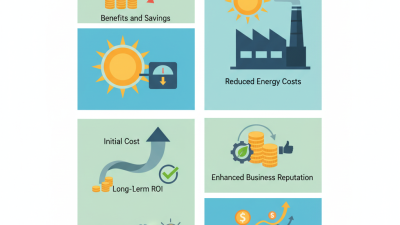
When considering solar panels for your business, understanding costs and return on investment is crucial. A report by the National Renewable Energy Laboratory indicates that commercial solar installations can provide a payback period of around 5 to 7 years. After this period, businesses can save thousands in energy costs. Depending on location, savings may reach upwards of 70% on electricity bills, making this an attractive option.
Tips: Analyze your energy usage before deciding. This helps estimate the size and type of system needed. Additionally, a professional energy audit can reveal hidden savings and optimize your investment.
Another factor is the available incentives. According to the Solar Energy Industries Association, federal tax credits can cover about 26% of installation costs. Many states also offer rebates and financing options. These incentives can significantly decrease upfront expenses.
Tips: Keep track of policy changes. Incentives can vary and may change frequently, impacting your investment strategy. Don’t overlook local regulations or limitations that could affect your installation. Understanding your local market is key to maximizing ROI.